The Seated Dumbbell Overhead Press: A Professional Guide to Setup and Form
The setup for the seated dumbbell overhead press appears straightforward—grab the weights, sit, hoist, and begin—but the mechanics underpinning this shoulder-dominant movement frequently confound lifters. A suboptimal setup leads to unstable dumbbells, unnecessary shoulder stress, and wasted energy that should be directed toward shoulder hypertrophy and strength gains.
Unlike barbells, dumbbells require greater effort and control: they expose bilateral imbalances, engage stabilizer muscles more intensely, and penalize flawed form. Your pre-lift checklist is the difference between an effective press and a rep that risks injury or limits progress.
Below, I guide you through safe dumbbell positioning (no spotter required), how to lock your body into the bench, and the critical role of breathing/bracing. Master this setup, and you’ll see consistent gains.
Your Dumbbell Shoulder Press Pre-Checklist
While most lifters aim to lift heavy, doing so without injury is the paramount goal. Here’s how to prioritize both:
1. The Pick-Up and Lap Position
The press commences at the rack—not when the weights are overhead. Ripping dumbbells off the rack recklessly invites injury—treat the pickup as the initial phase of the lift.
Grab dumbbells with control: Hinge at the hips, maintain a neutral spine, and lift the weights off the rack using the same form as a deadlift from the floor.
Rest on thighs: Sit upright on a 70-degree bench and place the dumbbells vertically on your thighs—this lap position acts as the launch point for moving the weights overhead.
Maintain vertical posture: Keep your chest elevated and core engaged.
Cues:
Internal: “Long spine, tall chest.”
External: “Rest the weights on your thighs—do not struggle with them.”
Coach’s Tip: If you cannot control the dumbbells in the lap position, reset or reduce the weight—a unstable setup will result in an unstable press.
2. Getting Dumbbells Into Position
No spotter? Not a concern if you know how to position the dumbbells correctly. The objective is to use your legs and core to guide the weights, rather than relying solely on shoulder strength.
Lap to shoulders: With dumbbells vertically resting on your thighs, inhale and lean back onto the 70-degree bench.
Kick and guide: Execute a controlled knee kick to move one dumbbell at a time toward your shoulder.
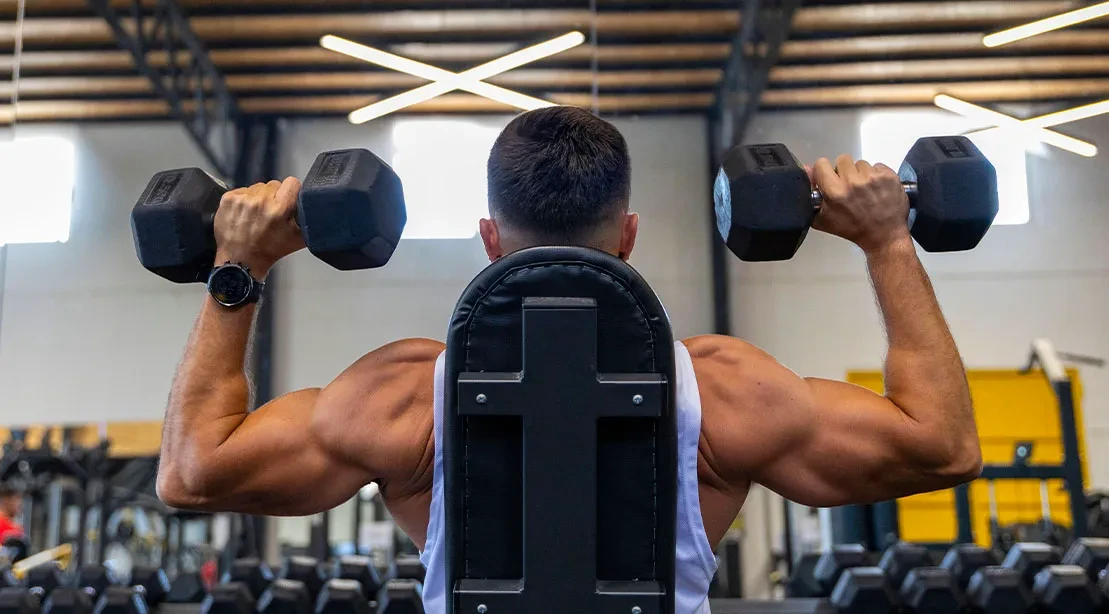
Lock and stack: Once both dumbbells are at shoulder level, your elbows should be slightly below your wrists, with the weights stacked near your anterior deltoids. Hand position can be forward-facing, angled, or neutral.
Cues:
Internal: “Guide the weight—do not fight it.”
External: “Kick, catch, stack.”
Coach’s Tip: If the dumbbells drift or your joints misalign during the lock-and-stack phase, pause, reset, and retry.
3. Foot and Seat Position
A strong press begins with a stable foundation. Neglecting lower-body and seat positioning turns every rep into a balance challenge—securing your base allows your shoulders and triceps to function optimally.
Anchor feet: Press your feet into the floor as if attempting to move the bench backward.
Secure glutes and hips: Maintain firm gluteal contact with the bench and avoid forward sliding.
Back against the pad: Press your lower back and shoulders into the bench to stabilize your spine and establish an optimal pressing angle. Retract and depress your shoulder blades without overarching your lower back.
Cues:
Internal: “Tight glutes, retracted and depressed shoulder blades.”
External: “Drive feet through the floor; press your back firmly into the bench.”
Coach’s Tip: If your feet shift or glutes slide, you’re losing energy—reset before the next rep.
4. Breath and Brace
Overhead pressing requires more than shoulder strength—it demands core stability. A subpar breath and brace turn your torso into a weak link, leading to lower-back overextension and diminished overhead strength.
Deep inhale: Take a diaphragmatic breath that expands 360 degrees (front to back, side to side).
Firm brace: Engage your core as if preparing to absorb a punch. Keep your ribs depressed (not flared) and aligned with the anterior hip bones.
Hold and press: Sustain the brace as the dumbbells move overhead. Exhale during the press; inhale on the eccentric phase (lowering).
Cues:
Internal: “Fill the belly, depress the ribs.”
External: “Inhale deeply, exhale forcefully.”
Coach’s Tip: If your lower back begins to overarch, you’ve lost core brace—reset your position before the next rep.
The Green Light Checklist (Final Pre-Rep Check)
This takes seconds to complete but ensures every rep starts from a position of strength. Mental run-through:
Feet planted: Firmly pressed into the floor.
Glutes anchored: Hips securely fixed to the bench.
Shoulder blades set: Retracted and depressed against the bench pad.
Dumbbells stacked: Resting at shoulder height with neutral wrists and elbows below the weights.
Core braced: Diaphragm filled with air and ribs depressed.
Eyes forward: Gaze directed straight ahead.
You’re now ready to press.
Common Setup Mistakes to Avoid
Even experienced lifters shortcut setup steps—until it leads to injury. Avoid these errors:
Reckless rack pickup: Rounding your back to yank heavy weights off the rack is unsafe. Always hinge at the hips and lift with control.
Over-reliance on arms: Shrugging or muscling dumbbells into position strains the shoulders—always use the knee kick and guide method.
Glute/lower-back displacement: Allowing glutes to slide or lower back to lift off the bench creates instability and back stress—keep glutes fixed and core braced.
Poor joint stacking: Starting with elbows too wide places shoulders in a vulnerable position—keep elbows below dumbbells and wrists aligned with elbows.
Pressing without bracing: Lifting with a relaxed core leads to lower-back overextension—always breathe and brace before each rep.
Final Note
Mastering the seated dumbbell overhead press setup is not about perfection—it’s about consistency in prioritizing form over ego. With this knowledge, you can execute the movement correctly, safely, and effectively.
Now go press with purpose.
Overhead Dumbbell Press: Build Bigger Shoulders and Anterior Delts
Share this article: