28-Days-to-Lean Meal Plan
With the right plan and the right discipline, you can get seriously shredded in just 28 days.
Read article
When it comes to building strong, muscular hamstrings, most lifters rely on heavy Romanian deadlifts (RDLs) or leg curl variations—often overlooking that bodyweight exercises can still deliver significant hamstring stimulation.
Resistance is resistance, whether from a dumbbell or gravitational pull. Your hamstrings do not discriminate between resistance types; they respond to tension, resistance, and movement quality—and the single-leg hip extension hamstring curl on a stability ball excels in providing all three.
This challenging bodyweight exercise integrates hip extension and knee flexion, requiring synergistic engagement of the glutes and hamstrings while maintaining core rigidity. Whether training at home, complementing a lower-body day, or developing your posterior chain, this movement deserves a place in your workout rotation.
Let’s Dive In
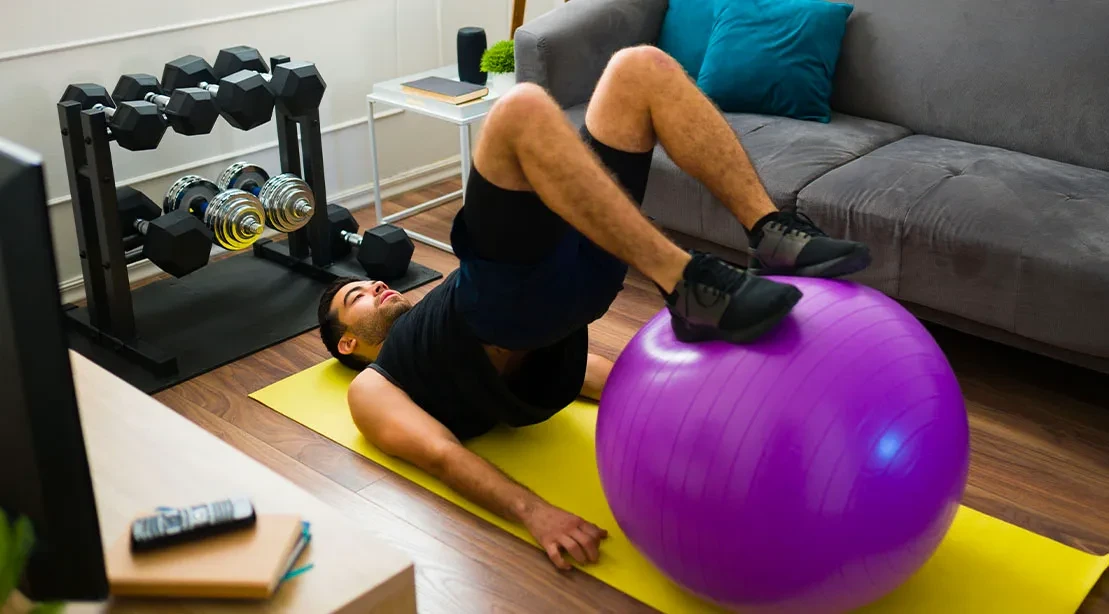
The single-leg hip extension hamstring curl is a stability ball-based bodyweight exercise that combines two fundamental hamstring functions: hip extension (driving the hips upward) and knee flexion (curling the leg). Unlike most hamstring exercises—which isolate knee flexion—this variation sequences hip extension first, followed by a hamstring curl, creating a more comprehensive stimulus.
To perform it: Place one foot on a stability ball, drive the hips upward to full extension, then curl the ball toward the glutes using the working hamstring. The movement simultaneously targets the glutes, hamstrings, and core while challenging dynamic stability.
Proper Form Overview
Before exploring benefits, let’s emphasize form—critical for maximizing results and minimizing injury.
Key Benefits of the Single-Leg Hip Extension Hamstring Curl
As fatigue sets in and hamstring burn intensifies, recalling these benefits reinforces the exercise’s value:
1. Runner-Centric Advantages
The integrated hip extension and knee flexion mimic the biomechanics of a running stride. This not only builds hamstring strength but also trains synchronous glute-hamstring activation—exactly how these muscles should work together during running.
2. Dynamic Instability Simulation
Unlike fixed machines, the stability ball introduces a shifting, unstable surface—analogous to the variable terrain of roads, trails, or tracks. Each rep requires stabilization against rotational and lateral displacement (mirroring foot-strike challenges in running). This instability enhances hamstring reactivity and resilience, reducing injury risk while improving stride efficiency.
3. Glute-Hamstring Coordination
Weak glutes and hamstrings are a risk factor for injury and performance decline in lower-body movements. This exercise demands synergistic contraction of both muscles to elevate the hips and retract the ball, fostering neuromuscular coordination that improves pelvic stability under fatigue and mechanical stress.
4. Injury Prevention
Hamstring strains typically occur during the eccentric phase (when the muscle lengthens under tension)—not concentric knee flexion. Research shows eccentric knee flexor exercises like this reduce strain risk by:
Enhancing eccentric knee flexor strength
Increasing hamstring extensibility
Common Form Mistakes (and How to Fix Them)
Maintaining focus is critical—tension and mindful movement drive this exercise’s effectiveness. Avoid these errors:
1. Sagging Hips
Issue: As fatigue accumulates, lifters often compromise hip extension during the curl phase, diminishing gluteal and hamstring tension and negating the exercise’s intent.
Correction: Keep the glutes contracted throughout the movement. Focus on driving the hips toward the ceiling as you curl. If hip height cannot be sustained, regress to the bilateral (two-leg) variation until strength improves.
2. Unnecessary Hip Rotation
Issue: The interplay of instability and unilateral loading can cause loss of control and hip twisting, compromising movement integrity and creating asymmetrical lower-back loading.
Correction: Maintain a neutral torso and braced core. The non-working leg must stay aligned with the hips (avoid lateral deviation). A useful cue: Imagine balancing a glass of water on your pelvis—prevent spillage.
3. Rushing Repetitions
Issue: Fatigue often leads to rushing through reps to tolerate discomfort, relying on momentum instead of muscular control.
Correction: Slow the tempo. Use a 2-second concentric (curl) phase and 3-second eccentric (lowering) phase. Slower movements increase time under tension (TUT)—a critical variable for muscle hypertrophy and strength development.
Programming Recommendations
The single-leg hip extension hamstring curl functions effectively as an accessory exercise on lower-body days or as part of a core stability circuit. Below are evidence-based set/rep guidelines:
| Goal | Sets × Reps | Tempo (Curl/Lower) |
|---------------------|-------------|---------------------|
| Muscle Hypertrophy | 3–4 × 10–12 | 2 seconds / 3 seconds |
| Strength Development | 3–4 × 8–10 | 2 seconds / 3 seconds |
For runners or those prioritizing stability, add 1–2 sets to your lower-body routine 2–3 times per week.
This exercise proves that bodyweight training can be as effective as loaded movements—when executed with focus, form, and intent. Integrate it into your plan to build resilient, functional hamstrings.
Stability Ball Hamstring Curl: Improve Strength and Injury Prevention
Share this article: